
By John Rupert | Strange Maine | November 1, 2026
PORTLAND/GORHAM, ME — Questions regarding administrative oversight and transparency within the University of Southern Maine (USM) Police Department have intensified, as a widening discrepancy emerges between official administrative declarations and eyewitness source accounts detailing serious misconduct.
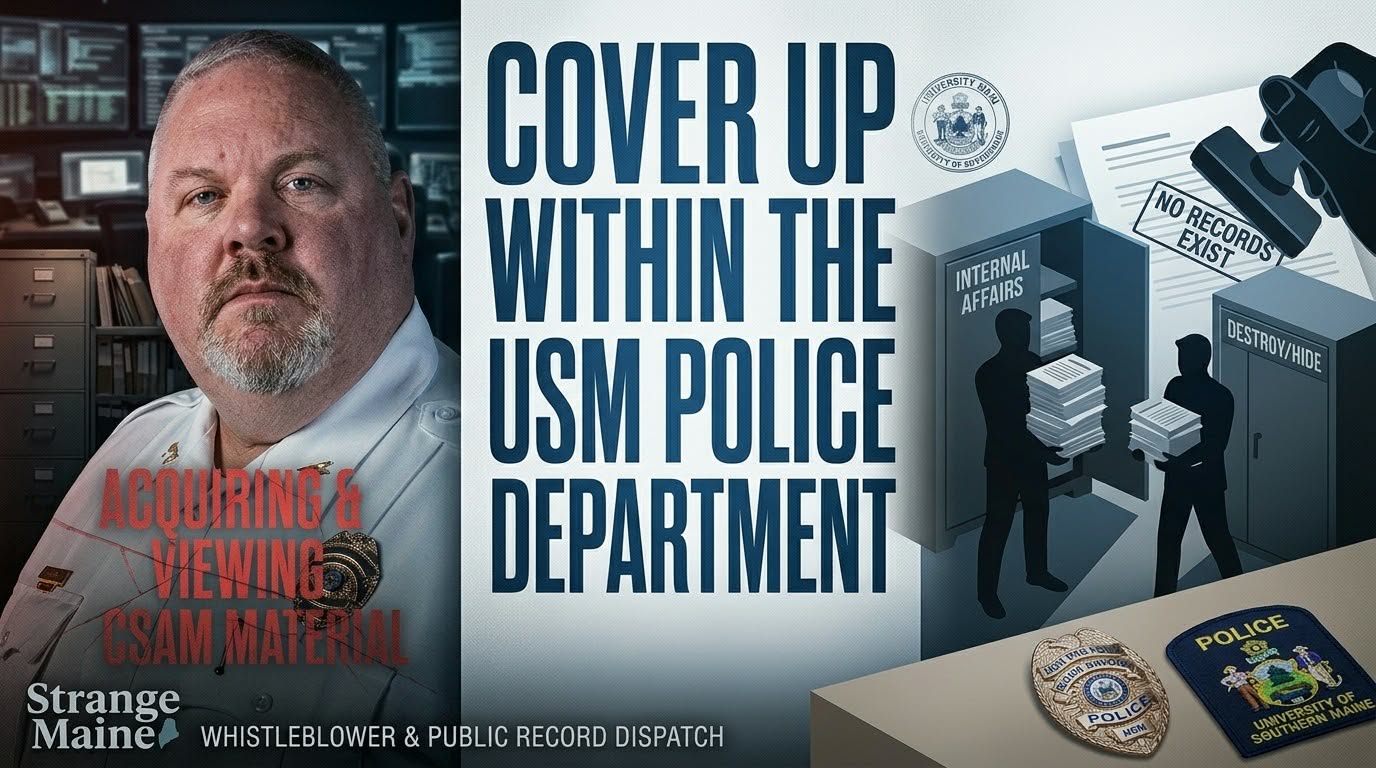
The Stonewall: ‘No Records Exist’
In response to Freedom of Access Act (FOAA) inquiries targeting internal affairs files, misconduct reports, and administrative inquiries regarding Deputy Chief Timothy Farwell, university officials issued a definitive statement: “no non-privileged records exist.”

This statutory denial legally asserts that USM administration never generated or preserved a single written internal investigation, administrative review, or disciplinary record regarding Deputy Chief Timothy Farwell.
Behind the Blue Wall: Whistleblowers Describe a Different Culture
The administrative claim that no records exist stands in stark contrast to the testimony of former USM police personnel. Confidential sources and former department staff describe a deeply troubling command culture that prioritized public relations over accountability:
- Allegations of Unreported Inquiries: A former USM Officer has stated that current Deputy Chief Farwell was subject to external law enforcement inquiry regarding the possession of child sexual abuse material. The source claims the matter was handled internally to avoid negative public relations for the university.
- Pattern of Retaliation and Oversight Failures: Sources allege systemic issues within the department, including questionable hiring practices, sudden terminations following internal policy disputes, and the minimization or mishandling of critical incident reports to protect the university’s public image.
- Suppression of Internal Dissent: Whistleblowers report that officers who raised questions regarding protocol, constitutional standards, or administrative directives faced swift professional isolation and retaliation rather than institutional support.
These disclosures paint a picture of an environment where severe misconduct claims could be effectively silenced or sidelined.
A Study in Contrast: How Husson University Handled the Same Crisis
USM’s ‘no records’ defense appears particularly glaring when compared to the immediate, decisive action taken recently by Husson University in Bangor.
In late October 2026, when former Husson University employee and assistant coach Jonathan Houck was arrested by Bangor police and charged with possession of child sexual abuse material, the university didn’t claim no records existed.
Instead, Husson administration:
- Immediately placed Houck on administrative leave.
- Escorted him off campus upon learning of the law enforcement investigation.
- Issued a public statement confirming his immediate termination upon verification of the criminal charges.
Command Accountability: The Silence of Chief Gráinne Perkins
The gap between USM’s administrative stance and the decisive model demonstrated by Husson University raises serious questions about command accountability at the highest level of USM Public Safety.

Gráinne Perkins serves as the Vice President for Public Safety and Chief of Police at USM. As Chief, she oversees department standards, personnel compliance, and the institutional response to misconduct allegations.
Her administration’s official position, that no paper trail exists regarding allegations involving a top-ranking deputy chief, contrasts sharply with the established pattern of immediate, transparent, and documentable action expected when law enforcement officers or university staff face severe criminal allegations. Public safety is compromised when institutional protection allows personnel to retain rank or advance without verifiable documentation of misconduct accountability.
The Ongoing Audit
While USM continues to issue blanket denials of existing records, Strange Maine has widened the public records audit. Expanded Freedom of Access Act requests have been issued to state licensing authorities (the Maine Criminal Justice Academy) and external law enforcement agencies to identify and archive the inter-agency communications that may exist regarding these unaddressed allegations.
Leave a Reply